Herringbone and Double Helical Gears for Heavy Drives
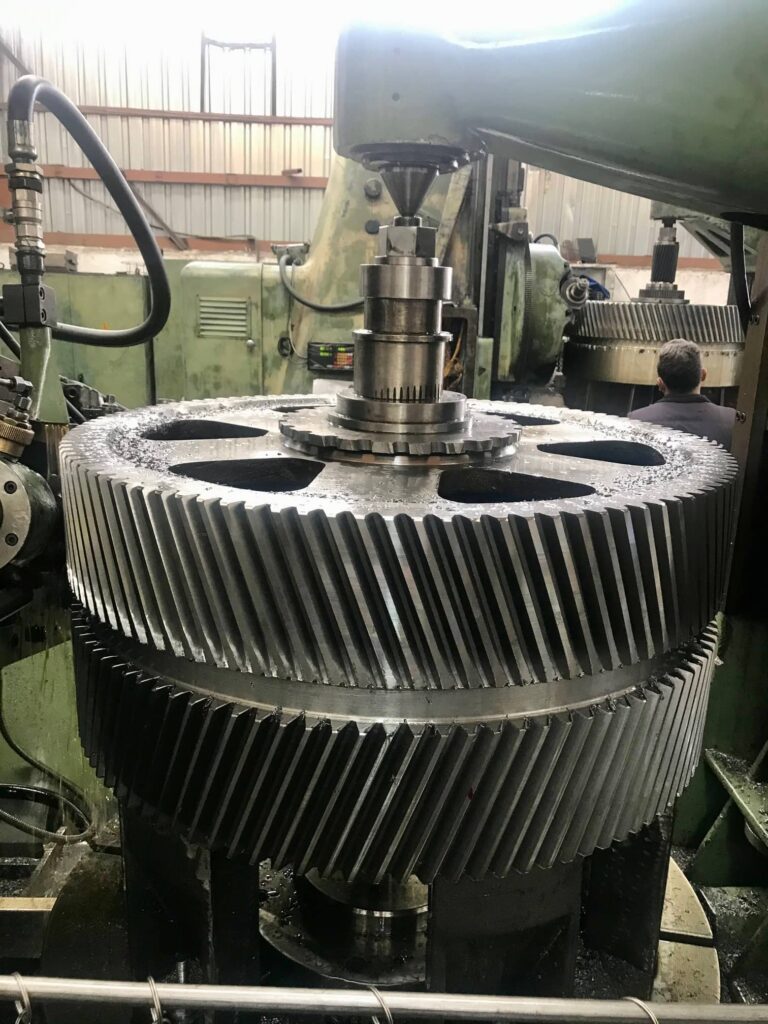
Two opposed helices on one gear cancel axial thrust and let a single stage carry very high torque. We manufacture double helical gears and herringbone-type gears to drawing for mills, crushers, rolling mills and marine drives.
- Ø1,800 mmmax. diameter
- Module 30max. module
- No thrustbalanced helices
- 3.1material certificates
High Torque Without Axial Thrust
A double helical gear has two rows of helical teeth with opposite hands. The axial forces of the two halves cancel each other, so the bearings carry radial load only. The overlap of two helices also makes engagement very smooth – ideal for large, slow, heavily loaded drives.
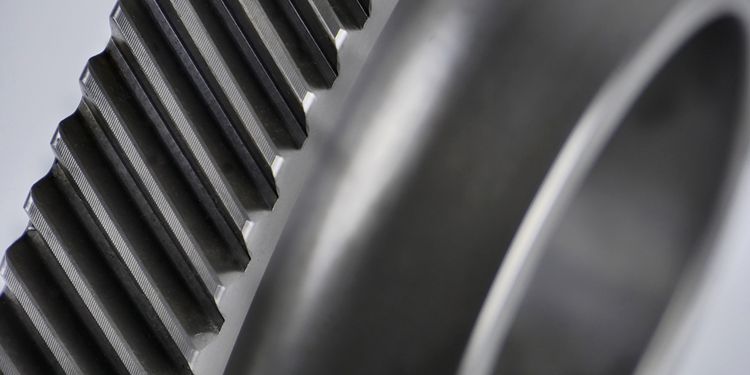
True herringbone gears have no gap between the halves; double helical gears have a central groove that lets the hob run out. Nika Gears manufactures double helical gears with a centre gap, matched to your drawing and pinion.
At a glance
- Sizesmedium to large gears
- Moduleup to 30
- Designdouble helical, centre gap
- Helixopposed, to drawing
- Materials42CrMo4, 34CrNiMo6, 18CrNiMo7-6
- HardeningQ+T, induction, nitriding
- Supplygear and pinion sets
Double Helical Gear Specifications: What Can We Make?
| Parameter | Range |
|---|---|
| Outside diameter | up to Ø1,800 mm |
| Module | up to 30 |
| Helix angle | typically 25–40°, to drawing |
| Centre gap | to drawing, for hob run-out |
| Apex alignment | checked between the two halves |
| Materials | 42CrMo4, 34CrNiMo6, 18CrNiMo7-6, forged |
| Heat treatment | quench and temper, induction hardening, nitriding |
| Documents | 3.1 certificates, UT on forgings on request, gear measurement |
Ranges are typical. Send your drawing and we confirm feasibility for your exact part.
Floating Pinions and Apex Alignment
In a double helical set one shaft is usually allowed to float axially, so the two helices share load equally. That only works if the apex of the two helices on each gear is accurately aligned. We measure apex alignment and helix deviations on both halves and report them with the gear.
For a matching pinion cut on the shaft, see pinion shafts.
- Both helices measured
- Apex alignment reported
- Gear and pinion as a set
Where Are Double Helical Gears Used?
Industries that use our double helical gears: steel and metal · mining · power generation · sugar
Need the gearbox housing too?
Large welded gearbox housings are produced by our sister company Nika Steelworks, ready to be machined and assembled with the gears.
Questions About Herringbone Gears
What is the difference between herringbone and double helical gears?
A true herringbone gear has the two helices meeting with no gap. A double helical gear has a groove in the middle so the hob can run out. Both cancel axial thrust; double helical is the common industrial design.
How large can you make double helical gears?
Up to Ø1,800 mm and module 30, with gear and pinion supplied as a set.
Do you make the matching pinion?
Yes, usually as a double helical pinion cut on the shaft. See pinion shafts.
Which industries use herringbone gears?
Steel rolling mills, cement and mining mills, sugar mills, marine propulsion and other heavy, slow drives. See our industries.
Double Helical and Herringbone Gears Explained
Double helical gears solve the main drawback of single helical gears: axial thrust. By placing two helices of opposite hand side by side, the axial forces cancel inside the gear. The bearings carry only radial load, and the gear can use a large helix angle for very smooth, quiet engagement.
Herringbone versus double helical
Historically, herringbone gears were made with the two helices meeting at an apex, which requires special shaping machines. Modern industrial practice uses double helical gears with a central gap, which allows standard hobbing. Both designs are often called herringbone gears in purchasing; we manufacture to the geometry on your drawing.
Where they make sense
Double helical gears are used where torque is high and speed is low to moderate: rolling mill pinion stands, cement and mining mills, sugar cane mills, marine reduction gearboxes and large turbine gearboxes. In these drives a failed gear means a stopped plant, so material, heat treatment and inspection matter as much as geometry.
Material and heat treatment
Large double helical gears are usually forged from 42CrMo4 or 34CrNiMo6 and through-hardened, induction hardened or nitrided. Smaller, highly loaded sets may be case hardened and ground. Forgings can be ultrasonically tested on request, and every part is traced to its EN 10204 3.1 certificate.
Manufacturing and inspection
We hob both helices in one set-up where possible, so the apex stays aligned. Both halves are measured for profile, lead and pitch, and apex alignment is reported. Gear and pinion are supplied as a matched set.
For heavy drives, the gearbox housing matters too – our sister company Nika Steelworks fabricates and machines large welded housings. Send a drawing for a quotation on double helical gears.
Send a gear drawing. Get an answer within 24 hours.
Include the PDF or STEP file, module or DP, number of teeth, material, heat treatment, accuracy grade and quantity. We reply with questions or a quotation.